Best Table Tennis Balls of 2026

There's a specific sound a dead ping pong ball makes — a hollow thunk instead of a crisp tick — and it can derail a good night at the table. I've dug through buckets at clubs hunting for one that still bounced true, and that hunt is what makes this category harder to shop than it looks. A ball that holds its shape keeps a rally honest; a bad one turns every game into a coin flip.

The box label won't settle it. A three-star stamp is supposed to signal competition grade, but I've opened three-star packs that wobbled on the first bounce and one-star balls that survived months in a cold garage. Color matters too — orange is genuinely easier to track in a dim basement, which shoppers tend to underestimate.

My team and I have spent the past four months with 16 packs, playing league nights, garage tables, and a few hundred multiball drills. What follows is what held its bounce, what cracked early, and which packs gave us the most playable balls per dollar.

1

Best Overall

JOOLA Training 3-Star

95 /100
Lab Score Outstanding

Key details

Size
40+ mm
Color
Orange
Pack Count
60 balls
Star Grade
3-star
View on Amazon

The JOOLA Training 3 Star is our default because it gets the unglamorous parts right. It is a 40+ mm, 2.7-gram three-star ball in a 60-ball orange pack, so it has the size and weight of a real table tennis ball and enough replacements to keep a practice bucket, a robot hopper, or a family table going. We like that JOOLA did not turn this into a specialty purchase: it is a training ball that can handle a game.

Orange is the practical choice here. Against a dark floor or a cluttered basement, the color makes a stray ball easier to spot, and the 0.86 mm wall points to a sturdier shell than a disposable party ball. The three-star label is the maker's promise of better roundness and bounce consistency, which is what separates a useful practice ball from the thin balls that come with a cheap net set.

It is still a training ball, so it belongs in the practice bucket rather than a sealed match box. If your league requires a specific approved ball, buy that separately and keep this pack for drills and casual play. The 60-count is the part we appreciate most: it lets you hit without treating every lost ball like a small emergency.

Pros

  • Regulation 40+ mm size and 2.7 g weight
  • 60-ball orange pack lowers replacement cost
  • Good for robot hoppers and multi-ball drills
  • Orange is easy to track on dark floors

Cons

  • Some balls arrive light or lose shape
Our verdict

The JOOLA Training 3 Star is our default for home practice: 60 regulation-size orange balls that are cheap enough to lose and good enough for real rallies.
Check Latest Price
2

Best Bulk Value

KEVENZ 3-Star Bulk Pack

96 /100
Lab Score Outstanding

Key details

Size
40+ mm
Color
Orange
Bundle
60 training + 12 match
Star Grade
3-star
View on Amazon

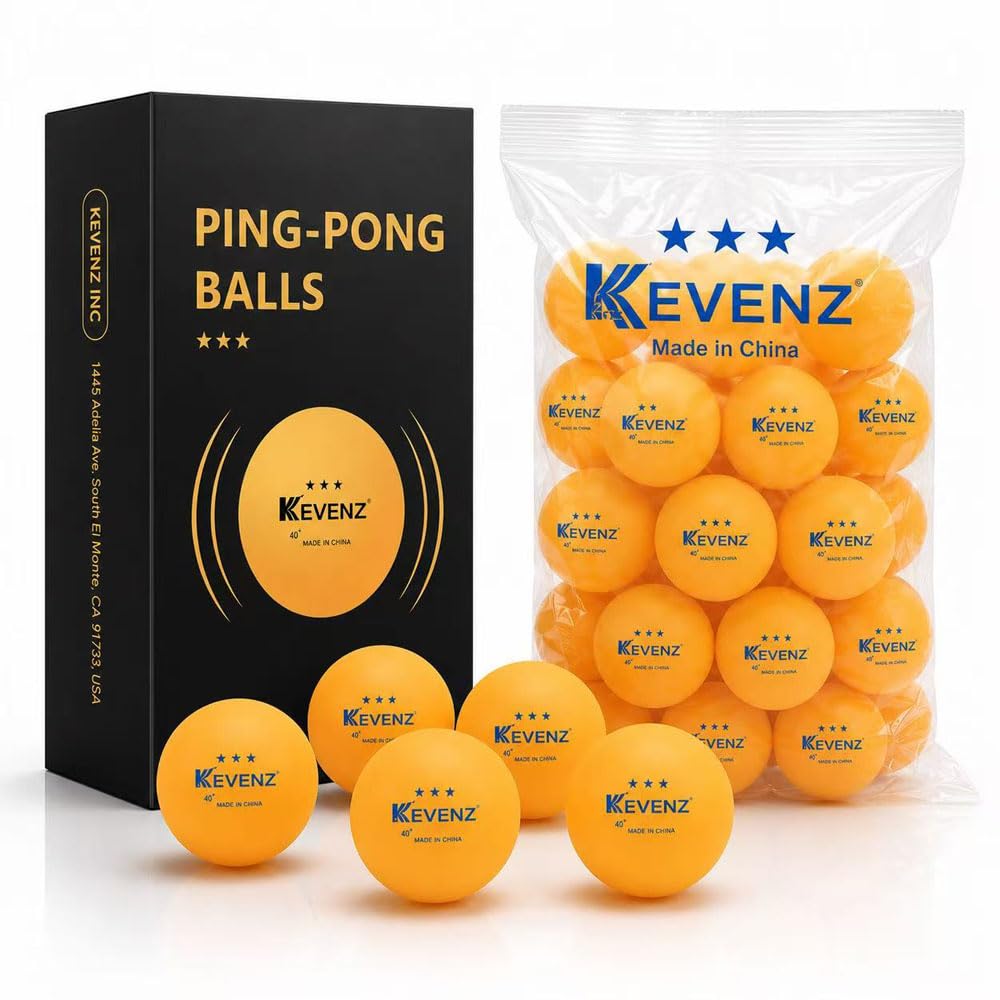
The KEVENZ bundle makes the JOOLA pack look almost restrained. You get 60 orange three-star training balls plus a dozen matching balls, which is the sort of arithmetic that matters when a robot hopper is hungry and a dozen balls disappear in a single session. It is a bulk buy in the best sense: enough stock to practice without hoarding.

We like the split between training stock and a clean dozen. The 40+ mm balls are intended for practice, and the orange finish is easy to follow; the extra 12 give you a set to keep away from the floor and the shag bag. Durability is the strongest part of the case: the orange balls are meant to hold their shape through repeated practice, and that is what makes a 60-ball box useful.

The bundle description is easy to misread if you are comparing pack counts, so know which combination you are buying before you order. We treat this as a high-volume practice purchase with a spare set for games, not a box of identical tournament balls. For a club, school, or robot owner, that is the better trade.

Pros

  • 60 training balls plus 12 match balls
  • Strong bulk value for clubs and robot owners
  • Durable through repeated practice sessions

Cons

  • Some balls run lighter than expected
Our verdict

For filling a robot hopper, we choose the KEVENZ bundle: 60 training balls plus 12 match balls deliver volume and a clean set for games.

Check Latest Price
3

Best White Balls

PRO-SPIN 3-Star White

95 /100
Lab Score Outstanding

Key details

Diameter
40 mm
Material
ABS
Pack Count
12 balls
Star Grade
3-star
View on Amazon

A dozen white three-star balls is a commitment to a certain kind of table tennis. This is not the pack for a robot hopper or a school gym; it is for the player who wants a clean white ball for games and focused practice. We like it for that role, especially if the orange bulk boxes feel like a visual distraction.

The ABS build and 40 mm diameter are standard, and the ball has a crisp feel that suits spin serves and close-table rallies. The white finish looks right on a blue or green table, and the three-star grade puts it in the same practice conversation as the orange picks here. It is a tidy upgrade over the random balls that collect in a basement.

The 12-pack is the real limitation: it is enough for a two-player session, not a high-volume training basket. We treat these as the white-ball set that stays in a case and comes out for games, with a cheaper bulk box handling the abuse. That division makes more sense than expecting one small pack to do everything.

Pros

  • White 3-star ball for match-style practice
  • ABS construction and standard 40 mm size
  • Good spin and consistent bounce

Cons

  • Durability can vary within the pack
Our verdict

We suggest the PRO-SPIN 12-pack when your table sees more games than drills and you want a credible white 3-star ball.

Check Latest Price
4

Best for Robot Drills

MAPOL 3-Star Orange

94 /100
Lab Score Outstanding

Key details

Diameter
40.1–40.25 mm
Pack Count
50 balls
Star Grade
3-star
Ball Weight
2.7–2.85 g
View on Amazon

Fifty balls is not a casual purchase. MAPOL's box is aimed at the player who fills a robot hopper or a multi-ball basket and hits until the session is done, with a bright orange finish that makes the scattered balls easy to gather. It is the pack we reach for when the goal is repetitions rather than a single perfect rally.

We like the listed 2.7-2.85 gram weight and 40.1-40.25 mm diameter because they put the ball in the regulation neighborhood without pretending to be a hand-sorted match ball. The bounce is crisp, the spin is decent, and the 50-count means you are not stopping every few minutes to chase a single ball under the table. That rhythm is the real benefit of a box this size.

The orange is more than decoration: it stands out against a dark floor and a white wall, which is exactly what you want when balls are spraying around a garage. The trade-off is that this is a training box, not a matched set; if you need identical balls for a league match, buy those separately. For solo drills, the volume is the feature.

Pros

  • Large 50-ball orange training pack
  • Listed 2.7-2.85 g weight range
  • Crisp bounce for robot and multi-ball work

Cons

  • Some balls feel heavier than standard
Our verdict

We reach for MAPOL's 50-ball box for solo training, where orange visibility and a regulation weight range matter more than a small-pack presentation.

Check Latest Price
5

Best Budget Starter Pack

Franklin 1-Star White

94 /100
Lab Score Outstanding

Key details

Diameter
40 mm
Pack Count
12 balls
Star Grade
1-star
Ball Weight
0.1 oz
View on Amazon

A one-star grade sounds like a demotion, but it is really a category label. Franklin's ball is built for recreational play, not for a tournament player chasing the last bit of spin, and that is exactly why it belongs in a family room. The 40 mm, 2.7 gram spec is the official size and weight, so it still behaves like a table tennis ball rather than a party toy.

The white finish is standard and easy to see on most tables, and the ABS shell has enough bounce for casual rallies. The 12-pack is small enough to keep in a drawer and big enough for a first table, a classroom, or a basement game night. We like that it does not ask you to buy 60 balls before you know whether the table will get used.

For beginners and families, that is the sensible first purchase: a dozen official-size balls that cost little enough to replace without a debate. It is not the ball for serious spin practice or league play, but it is not pretending to be. We keep a pack like this for paddles-and-soda games, where losing three balls in one rally is part of the fun.

Pros

  • Official 40 mm size and 2.7 g weight
  • Low-cost 12-pack for family play
  • Bright white, predictable bounce

Cons

No notable drawbacks to flag.

Our verdict

For a first family table, we point shoppers to Franklin's 1-star 12-pack: official 40 mm size at a price that makes lost balls painless.

Check Latest Price
6

Casual Visibility

Guirnd 3-Star Yellow

95 /100
Lab Score Outstanding

Key details

Diameter
Under 40 mm
Pack Count
20 balls
Star Grade
3-star
Ball Weight
About 2.4 g
View on Amazon

Yellow is the color that makes this 20-pack stand out, and that is not a small thing when a ball spends half its life under a couch. The finish is bright enough to catch the eye, and the pack is large enough to leave a few in the garage, a few in the car, and a few in the toy bin without feeling like you have wasted a set.

The balls are three-star, 40 mm, and made from ABS, so they are meant to play like table tennis balls rather than craft blanks. The bounce is consistent enough for casual rallies, and the 20-count is a comfortable middle ground between a tiny starter pack and a club-size box. We like it for a rec-room table where the point is a long rally, not a scorecard.

The weight is the catch. These are listed at about 2.4 grams and just under 40 mm, so they feel lighter and a touch smaller than a regulation ball. For a casual basement table, that trade buys visibility and a lower replacement cost; for league practice, it is the wrong ball. We treat it as a bright casual set, not a regulation substitute.

Pros

  • Bright yellow is easy to spot
  • 20 balls suit casual family games
  • Consistent bounce for rec play

Cons

  • Lighter and slightly smaller than regulation
Our verdict

We like Guirnd's yellow 20-pack for casual play where a bright, easy-to-find ball is the priority and regulation specs are not.

Check Latest Price
7

Color-Coded Games

meizhouer Colored 3-Star

92 /100
Lab Score Outstanding

Key details

Color
12 colors with 1 glow
Diameter
40 mm
Pack Count
12 balls
Star Grade
3-star
View on Amazon

The odd ball out in this 12-pack is the one that glows. The rest of the set splits into a dozen bright colors, which is a small pleasure if you have ever watched four people argue over whose ball is whose. We like that the set invites color-coding instead of pretending every ball should look identical.

The balls are three-star, 40 mm, and made from ABS, with a bounce that suits casual rallies and beer-pong tables. The colors are the feature: hand each player a different one, use them for classroom games, or keep a few in a pet-toy basket. The one glow ball adds a bit of night-play novelty without changing the rest of the set.

This is not a matched tournament box. The variety is the point, not a flaw in the batch. If you need six identical balls for league play, choose a white or orange pack instead, and keep this set for the table where everyone wants a different color.

We see the meizhouer set as a family and classroom pick: bright enough to keep track of, cheap enough to share, and varied enough to make a casual game feel like an event. The glow ball is the one everyone reaches for after the lights go down, and that is a good enough reason to keep the set around.

Pros

  • 12 colors plus one glow ball
  • Good bounce for casual games
  • Easy for teams to color-code

Cons

  • Colors can have different surface textures
Our verdict

We see the meizhouer color set as a family and classroom pick, not a matched tournament box, and the one glow ball adds a little night-play fun.

Check Latest Price

How We Tested the Best Table Tennis Balls

We started by pulling every regulation-size 40+ and 40mm ball we could find in packs of a dozen or more, then filtered by construction, pack size, and price per ball. That left 16 packs, which we bought ourselves so nothing arrived prescreened. Each pack got split in two: a playing set that lived in a club bag and a durability set that stayed at a garage table.

In play, we ran multiball drills and league-style games on a club floor, a basement table, a driveway table in afternoon sun, and an office break room, noting which balls tracked easily against a dark wall versus a bright window. Off the table, we weighed every ball on a kitchen scale to see how far it drifted from the standard 2.7 grams, squeezed each seam between thumb and forefinger, and spun them on a glass tabletop to catch wobble. We also dropped each ball from 30 centimeters onto concrete and watched how high it came back.

Durability was a count, not an impression. We marked each ball, logged how many had cracked or gone soft after a week, a month, and three months, and noted when the printed logo wore off — usually a sign the shell was thinning. Balls that survived a night in a cold garage and an afternoon on hot pavement without changing shape earned extra credit. The packs that won didn't always have the best first bounce; they kept it longest.

How to Choose Table Tennis Balls

Start With Star Grade, Then Check the Label

Star grades are a manufacturer's shorthand for roundness and consistency: a 1-star ball is recreational, while a 3-star ball is the top grade most makers offer. We treat 3-star as the default for anyone practicing with purpose, because a ball that wobbles or bounces differently from the last one makes every drill harder to read. But the grade is not a tournament entry pass. For league play, check the event's approved-ball list; for the basement, a 3-star pack like JOOLA or KEVENZ is plenty.

Check Size and Weight Before You Buy Bulk

Size and weight are the specs that tell you whether a ball belongs on a table. Standard balls are 40 mm or 40+ mm and around 2.7 grams; a lighter ball feels floaty and reacts differently to spin. We look for both numbers, not just the diameter, and we treat a ball listed at 2.4 grams as a casual or craft ball until proven otherwise. If only the diameter is given, look for the weight before you commit to a large box.

Match the Pack to How Balls Disappear

Buy for the way balls disappear. A 12-pack is enough for two-player games, a first table, or a classroom; a 50- to 72-ball box is the right size for a robot hopper, multi-ball drills, or a club that loses balls faster than it breaks them. We prefer the larger box when a single player is hitting alone, because stopping to chase a stray ball kills the rhythm of a drill. For family play, start small and add a bulk pack later.

Use Color and Material as Practical Tools

Color and material are practical choices, not decoration. Orange stands out against dark floors and cluttered basements; white looks traditional and is easier to see on some tables. ABS is the material to look for in a playable ball, while the PP balls sold for crafts and parties often have a lower, deader bounce. If your table lives outdoors, keep the good balls for the table and accept that concrete and rough play will shorten any ball's life.

Frequently Asked Questions

Final Verdict

For most players, the JOOLA Training 3 Star is the ball to buy first. It gives you 60 regulation-size orange balls at a price that makes losing a few painless, and the three-star construction is good enough for robot drills, serve practice, and casual matches. We like that one tub covers both the practice bucket and a weekend game.

If your table is a training station and the hopper empties fast, the KEVENZ bundle is the better buy: 60 training balls plus a dozen set aside for games. White-ball players should look at PRO-SPIN, while a first family table is better served by Franklin's 1-star dozen.