Best Steam Deck Cases of 2026

A Steam Deck is heavy, wide, and awkwardly shaped, which means the case you buy is doing one of two very different jobs. Some live on the console permanently and change how it feels in your hands; others swallow the whole thing and get thrown in a bag. Mix the two up and you end up with a case that fights the hardware — my first one squeezed the shoulder buttons and still left the corners bare.

We've spent the past four months testing 12 cases in both styles, and the gap between a snug fit and a loose one shows up fast: the Deck slides inside the shell, the zipper drags across the screen, the whole thing wobbles when you set it down. What a good case actually fixes is simpler than the listings suggest — it holds the console still, gives your palms something to grip, and takes the impact on its own corners instead of yours.

The details that separate the picks are the ones no product photo captures: whether the kickstand locks at an angle you'd really use, whether the strap fits across a full hand, and whether there's genuine room for a charger and cable or just a hopeful pocket. Below, each one earns its spot for a different reason.

1

Best Overall

JSAUX PC0104 ModCase

94 /100
Lab Score Outstanding

Key details

Case Type
Grip shell with snap-on front cover
Kickstand
Detachable zinc alloy bracket
Compatibility
Steam Deck LCD and OLED
Accessory Strap
Included silicone strap
View on Amazon

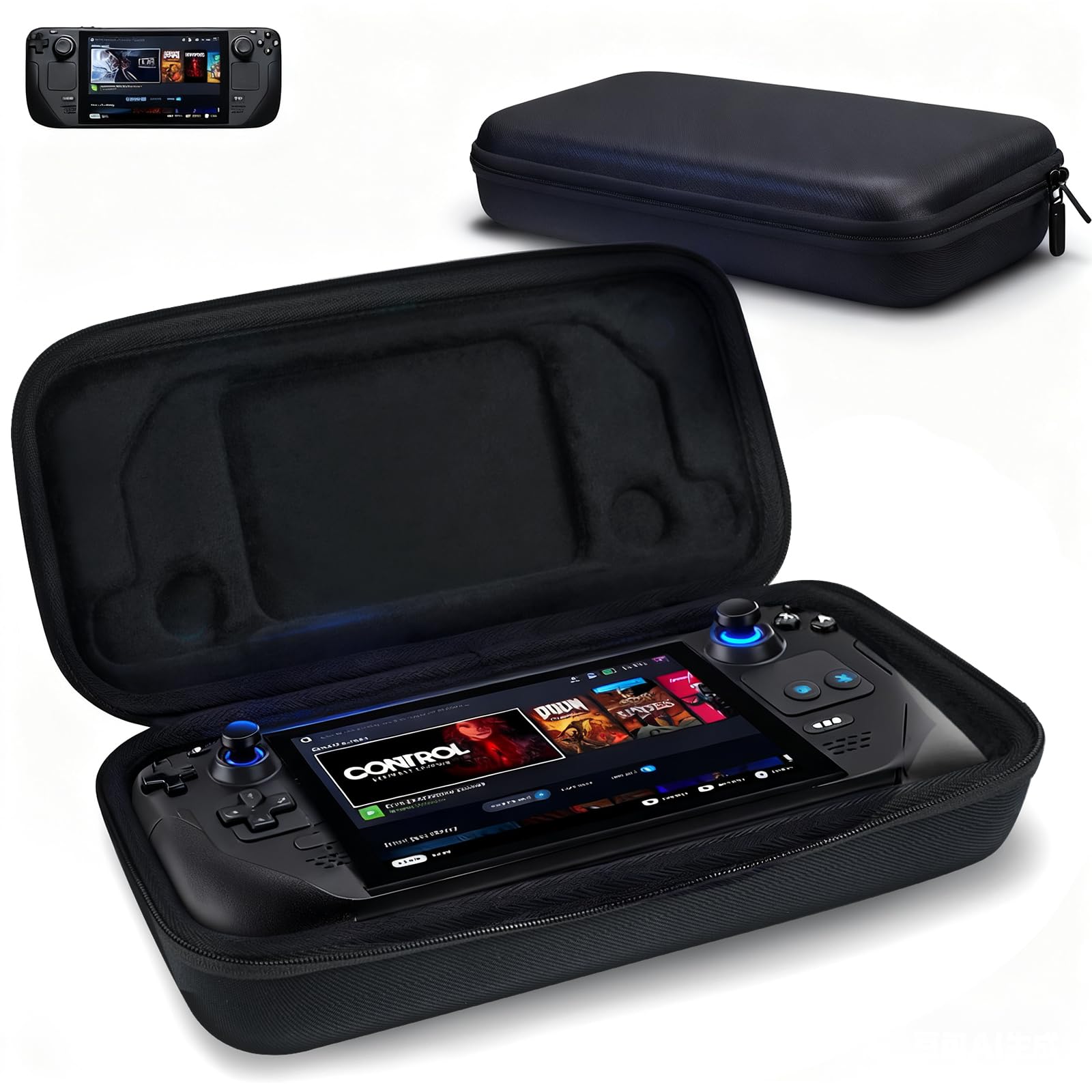
The front cover is what earns this case its place. A hard shell snaps over the screen and thumbsticks so the Deck can go straight into a bag without hauling Valve's carrying case along, and that one extra piece changes how a grip case gets used. Underneath it is a textured PC-ABS and TPU shell that adds grip without swallowing the buttons or triggers.

In the hand it feels like a grippier Deck rather than a bigger one. The textured edges land under your palms, the cutouts leave the sticks, triggers and ports where you expect them, and the cover comes off with a snap when you want to play. The detachable zinc alloy bracket slides onto the back as a kickstand; clip-on stands like this one are fine for a table session and less convincing when you lean on the screen, so treat hands-free play as a bonus rather than the reason to buy.

The silicone strap is the part we didn't expect to use. It loops onto the shell and holds a power bank or a USB-C hub flat against the back, which turns a spare battery into part of the console on a long flight instead of something loose in a bag. It's an add-on that could have felt gimmicky and instead earns its spot in the kit.

Pros

  • Snap-on hard cover shields screen and sticks
  • Textured grip without blocking controls
  • Detachable metal kickstand bracket
  • Silicone strap carries a power bank or hub

Cons

  • No room inside for a charger or dock
  • Too bulky for Valve's case with the cover on
Our verdict

We recommend it as the default: the snap-on front cover lets the Deck travel bare in a backpack, and the shell underneath is comfortable enough to leave on.
Check Latest Price
2

Best for Hauling Gear

JSAUX Carrying Case BG0106X

93 /100
Lab Score Outstanding

Key details

Devices
Steam Deck, ROG Ally, Portal
Dimensions
13.4 x 6 x 3.9 inches
Compartments
3
Listed Capacity
297 cubic inches
View on Amazon

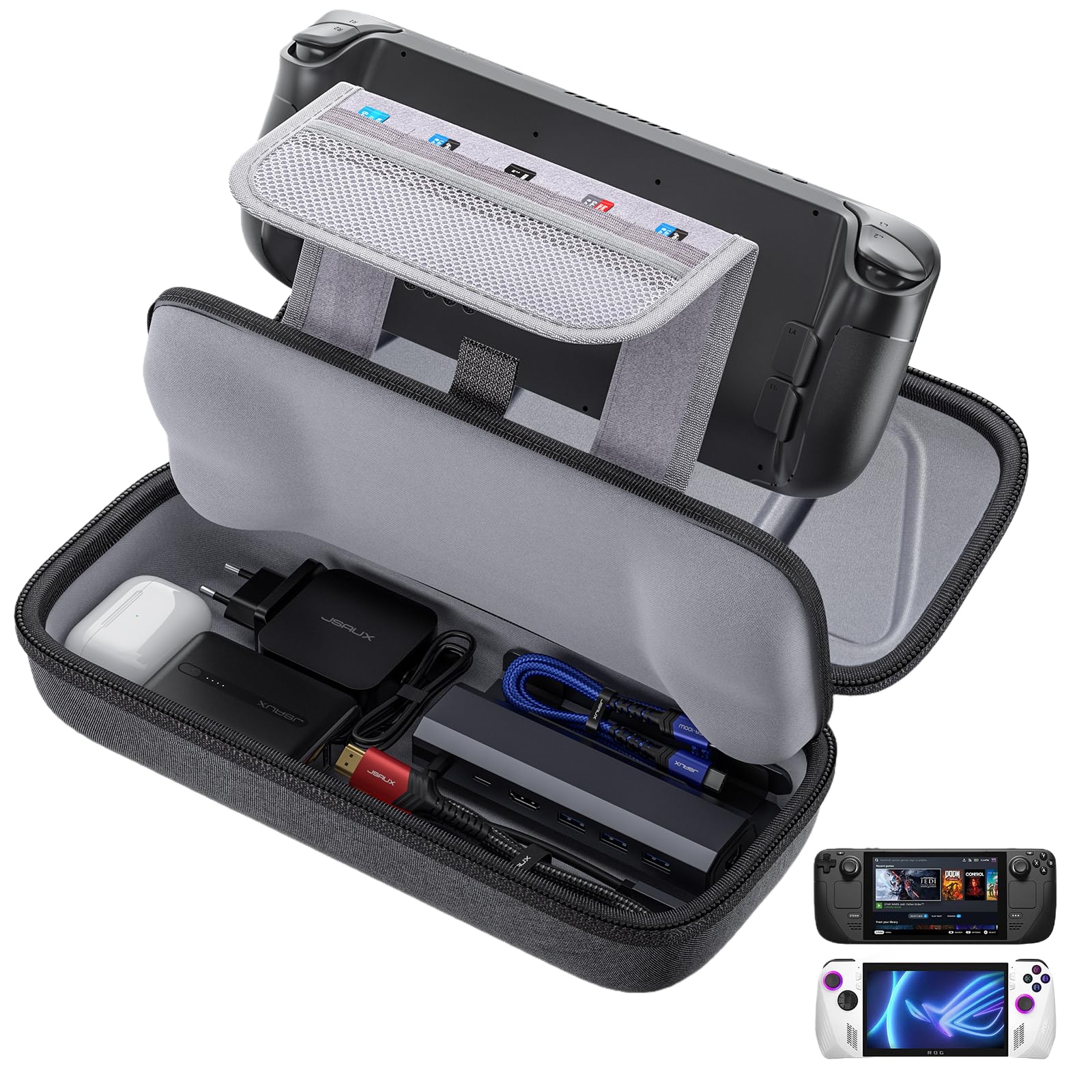
A charger, a dock, a power bank and a pair of headphones is a lot to carry alongside a handheld, and this case is built around exactly that pile. Inside there's a deep lower bay, a molded cradle with a Velcro strap across the Deck, and three compartments in a shell the listing puts at 297 cubic inches and 13.4 by 6 by 3.9 inches.

We take it whenever the Deck travels with its accessories rather than alone. The thickened EVA shell resists being squashed in a trunk, the groove molding keeps pressure off the screen, the double zipper runs cleanly around the lid, and the reinforced web handle takes the loaded weight without cutting into your hand.

Packing it rewards a little discipline: charger or dock in the lower bay, cables and a power bank in the upper section, Deck strapped into the cradle so it doesn't slide forward. And if your household rotates between a Steam Deck, an ROG Ally and a PlayStation Portal, one case covers all three.

Pros

  • Holds a charger, dock and cables
  • Stiff EVA shell with a reinforced handle
  • Velcro cradle keeps the Deck in place
  • Fits Steam Deck, ROG Ally and Portal

Cons

  • Big enough to be a separate bag, not a backpack insert
Our verdict

Buy this one if the Deck travels with its charger and dock — nothing else here swallows that much gear and still holds the console still.

Check Latest Price
3

Best Slim Travel Case

tomtoc Slim Carrying Case

93 /100
Lab Score Outstanding

Key details

Weight
11.6 oz
Zippers
YKK
Material
PU and felt
Dimensions
12.52 x 5.51 x 2.36 inches
View on Amazon

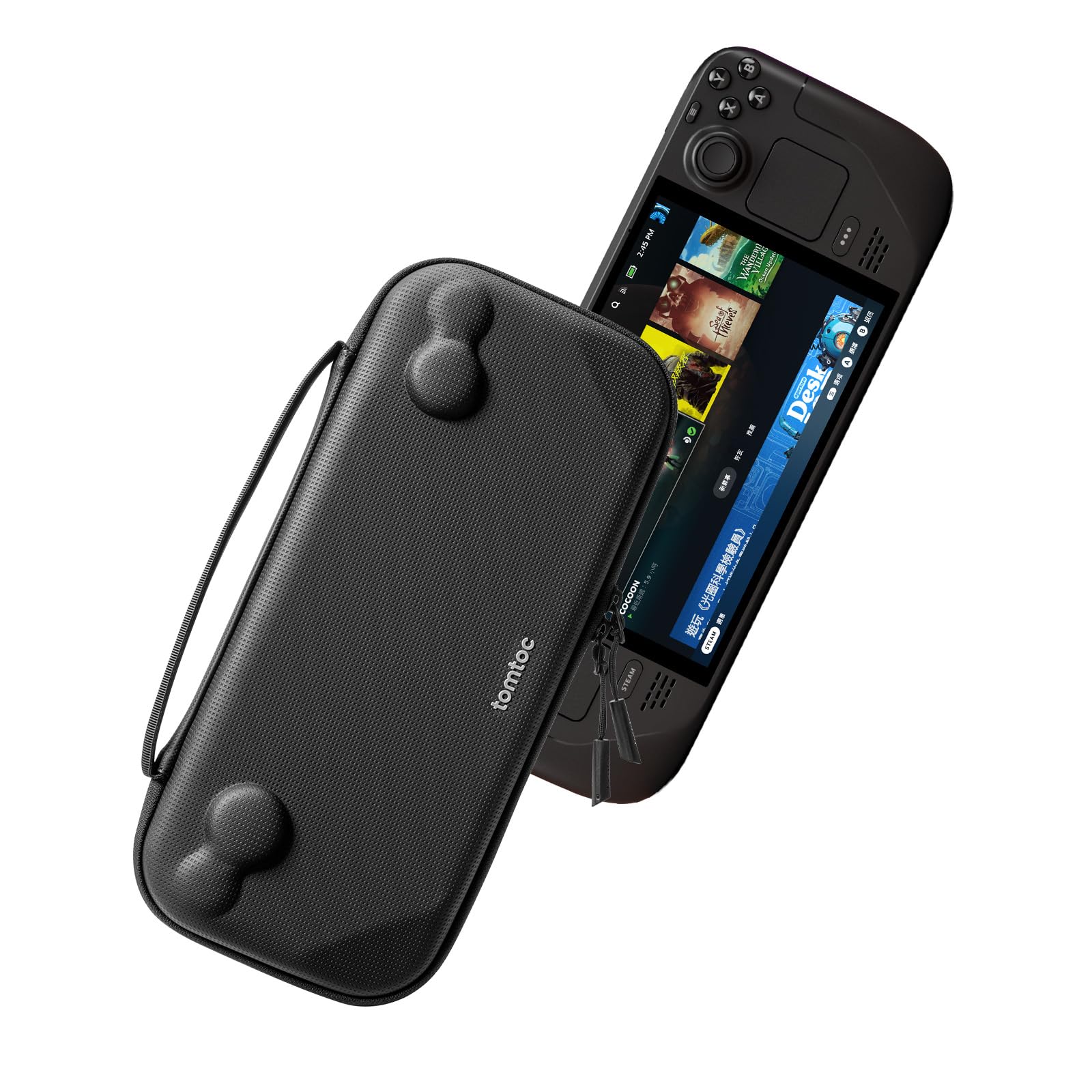
At 2.36 inches deep and 0.33 kilograms, this is the slimmest hard case in the group — closer to a hardback book than to a bag. That's the entire pitch: it's for a Deck that already rides in a backpack and doesn't deserve a compartment of its own.

The inside is molded rather than padded, with raised areas that follow the Deck's curves so the sticks and buttons aren't pressed in transit, and a felt lining that won't scuff the glass. There's a zippered pocket for a cable and a couple of SD cards, a splash-proof PU outer shell, and YKK zippers that feel a step above the usual.

Air travel is where it earns its keep: it slides into a personal item next to a laptop, and the hard shell means you can stop treating that bag like it holds something fragile. A low-profile shell fits inside; a kickstand case or a chunky grip shell doesn't, so settle the shell question before you buy the bag.

Pros

  • Slim hard shell well under a pound
  • Molded interior protects sticks and buttons
  • Splash-proof PU with YKK zippers
  • Slides into a crowded backpack

Cons

  • No room for a charger or dock
Our verdict

Our pick for a Deck that lives in a backpack: it's the slimmest hard case here and still keeps the sticks and screen covered.

Check Latest Price
4

Best Grip and Stand

Skull & Co. GripCase SD

93 /100
Lab Score Outstanding

Key details

Dock
USB-C cutout for docks
Shell
Soft, textured grips
Stand
75-degree stand design
Weight
4.59 oz
View on Amazon

Set the Deck down on a table with this case fitted and it stands there on its own. The back is molded to hold the console at roughly 75 degrees, so you get hands-free play with no kickstand to snap off — and since a folding stand is usually the first thing to feel flimsy on a grip case, we ended up appreciating that more than we expected.

The soft shell goes on and comes off without a fight, which matters if you move between docked and handheld, and the textured grips give your palms something to hold during a long session. At 130 grams it barely changes the weight in your hands.

Compatibility is where it quietly does more than expected: it lists support for both the LCD and OLED Deck, the USB-C cutout is shaped to clear the official dock and third-party ones, and the shoulder buttons are relieved so the case doesn't pinch your fingers. It's the case that stays on our own Deck at home.

Pros

  • Stands upright with no kickstand at all
  • Textured grips and an easy-on soft shell
  • USB-C cutout clears official and third-party docks
  • Shoulder buttons relieved to stop pinching

Cons

  • Soft shell with no cover for bag travel
  • Snug inside Valve's OLED case
Our verdict

Fit this to a Deck that gets played on tables: the molded back stands it up without a kickstand, and the grips are the best-feeling in this group.

Check Latest Price
5

Best for the Factory Case

Spigen Rugged Armor

92 /100
Lab Score Outstanding

Key details

Weight
6.7 oz
Included
Wrist strap
Material
TPU
Dimensions
11.96 x 4.78 x 1.62 inches
View on Amazon

A wrist strap on a handheld case sounds like something nobody asked for, and then you play lying on your back once and stop making jokes about it. That strap is the detail we keep coming back to; the rest of this one is a straightforward TPU bumper with a soft-touch finish and cutouts that line up.

At 190 grams and 1.62 inches deep it adds grip and drop protection without pushing the Deck out of Valve's carrying case, which is the balance most people are actually after. The texture is grippy without being sticky, buttons and vents stay clear, and it stretches on and off in seconds.

The official dock is the one place it fights you: the connector reaches, but the extra bulk can stop the Deck seating all the way down. A USB-C cable or a dock with a taller connector solves it, so it only matters if the dock is your main setup.

Pros

  • Fits inside Valve's own carrying case
  • Soft-touch TPU with a secure grip
  • Wrist strap included
  • Cutouts keep buttons and vents clear

Cons

  • Bumper only
Our verdict

The one to buy if you want more grip and drop protection without retiring Valve's carrying case — plus a wrist strap you'll use more than you expect.

Check Latest Price
6

Rugged Travel

Spigen Rugged Armor Pro

85 /100
Lab Score Excellent

Key details

Weight
1.48 lb
Materials
PU, EVA, foam, nylon
Dimensions
14.01 x 6.76 x 4.09 inches
Compartments
3
View on Amazon

This is the biggest case here: 14.01 by 6.76 by 4.09 inches and 670 grams before anything goes in it. It's built like a small gig bag, and it's meant to be carried on its own rather than wedged into a backpack.

The inside is more thought out than the outside suggests. A zippered mesh compartment on the lid takes a charger, a hidden pouch is sized for an AirTag, another compartment sits under the flap, and orange foam pads the corners. A Velcro strap with a suede lining crosses the screen so nothing rubs against the glass in transit.

The Deck doesn't fill the shell. The case is wider than the console, so it can slide sideways until it meets the molding, and the central strap doesn't wrap all the way around the body. It's held well enough to carry, but it isn't the locked-down cradle a molded travel case gives you, so pack it snug.

Where it makes sense is rugged travel with accessories: the foam, the stiff shell and the AirTag pocket add up to a case that protects the Deck and everything it needs. If the Deck mostly rides in a backpack, this is more case than you need — the tomtoc does that job in a fraction of the footprint.

Pros

  • Charger compartment plus hidden AirTag pouch
  • Foam corners in a stiff PU and EVA shell
  • Suede-lined strap across the screen
  • Fits Steam Deck and ROG Xbox Ally

Cons

  • No strap in the box, just a carabiner ring
Our verdict

For trips where the charger, cables and a controller come along, this is the most protective case here — provided you don't mind carrying it separately.

Check Latest Price
7

Budget Travel

MeloSync Carrying Case

92 /100
Lab Score Outstanding

Key details

Shell
Hard
Closure
Zipper
Pockets
Charger, cable, SD card
Compartments
3
View on Amazon

Three compartments, a top handle, and pockets cut for a charger, a cable and a few SD cards: this is a travel case that sticks to the basics. The shell is hard and the padding is shock-absorbent, so the Deck isn't riding against whatever else is in your bag.

Nothing here is clever, and that's mostly fine — no AirTag pouch, no kickstand, no extras beyond the pockets and the handle. What you get is a plain zip case that does the console-and-charger job without turning into a second bag.

We point anyone who wants a hard case for the Deck and a charger at this one. The interior is easy to see into when you're repacking at a gate, which counts for more than it sounds.

Pros

  • Hard shell with shock-absorbent padding
  • Pockets for charger, cables and SD cards
  • Three compartments in a compact case

Cons

  • No compartment sized for a dock
Our verdict

A straightforward hard travel case for the Deck and a charger; if you never pack the dock, this covers the job without the extra bulk.

Check Latest Price

How We Tested Steam Deck Cases

We started with a shortlist of roughly 30 cases pulled from retailer listings and handheld-community threads, then narrowed it by the specs that actually differ: grip shell versus travel case, hard shell versus soft, whether the interior had real storage for a charger and dock, and how each one handled the slight size difference between the LCD and OLED models. Twelve made it into testing, and we ran them for four months.

Each case went through the same routine: a week of daily commuting in a backpack next to a laptop, evening sessions on the couch, a couple of flights, and the unglamorous home life of docking the Deck, packing the charger, and digging the console out one-handed. We noted how much the Deck shifted once seated, whether we could reach the power button and both ports without pulling it free, and how the grip texture felt after an hour of play.

For protection we did what a clumsy person does — dropped each case from waist height onto hardwood, corners first, and checked for cracked shells and bruised consoles. We stuffed a charger, cable, and dock into every travel case to see what genuinely fit and what bulged the zipper, weighed each one packed, and slid it into a backpack sleeve to judge bulk. We also smelled the felt-lined interiors straight out of the box and checked stitching and scuffs after four months of use, since value only holds up if the case still looks intact by the end.

How to Choose a Steam Deck Case

Shell, travel case, or both

Three shapes cover almost everything. A grip shell wraps the back and sides and stays on while you play. A travel case is a box the Deck goes into, with room for accessories. The third option — a shell with a snap-on front cover — does both jobs, which is why the JSAUX ModCase leads this list: you keep the grip and gain a hard lid for the bag.

If the Deck leaves the house in a backpack more often than it sits on a shelf, that combination is worth seeking out. If it travels with a charger and a dock, a proper travel case earns its space instead.

Two fit questions to settle first

Ask two questions before you look at anything else: does the case have to go back inside Valve's own carrying case, and does the Deck have to seat on a dock while wearing it? Both answers eliminate options fast. A thin TPU shell like the Spigen Rugged Armor still slips into the factory case; a shell with a front cover or a kickstand generally doesn't.

The same bulk that blocks the factory case can lift the Deck off a dock connector, so check the shape of the cutout rather than assuming a USB-C hole means dock compatibility.

Let your accessory list set the size

Write your pack list before you choose a size. A console and a cable fit something like the tomtoc, at 160.57 cubic inches and 2.36 inches deep. Add a charger and a dock and you're into the JSAUX carrying case at 297 cubic inches and 3.9 inches deep, or the Spigen Rugged Armor Pro at 4.09 inches.

The trap is buying the big case just in case. Past about four inches deep it stops being a backpack item and becomes a bag you carry separately, which is fine on a trip and a nuisance on a commute.

Stands, grips and cutouts

Kickstands are the weak point of grip cases. A hinged stand that folds out is the part most likely to feel flimsy, and the ones here draw split reactions. A molded back that lets the Deck stand on its own, as on the Skull & Co. GripCase, avoids the mechanism entirely.

Cutouts deserve the same scrutiny. Face buttons should sit proud of the shell rather than flush with it, and the rear intake and top exhaust need to stay clear during a long session.

Frequently Asked Questions

Final Verdict

The JSAUX PC0104 ModCase is what we point most people to, because the snap-on front cover turns a grip shell into something you can throw in a bag — protection you don't have to think about, with a shell still comfortable enough to leave on.

If the charger and dock travel too, the JSAUX carrying case holds the whole kit. If the Deck mostly needs to disappear into a backpack, the tomtoc is the one that does it without bulk.