Best Microphone Shock Mounts of 2026

A shock mount does one job: it hangs your microphone in a web of elastic so the stand, the desk, and the floor below it stop showing up in the recording. Simple idea, fiddly execution. My team and I spent six months with 12 of them, and the ones still sitting on our desks share one habit — the mic holds still, and the mount doesn't fight you when you swap it out.

Fit turns out to be the whole ballgame, and it's what most shoppers check last. Mic bodies vary wildly in diameter, and stand threads come in 5/8-, 3/8-, and 1/4-inch flavors, so a mount that cradles a chunky USB condenser can leave a slim dynamic mic rattling like a marble in a can. An adapter that doesn't seat flush is the other quiet culprit.

Build quality matters more than the price tag suggests — cheap elastic stretches out within weeks, and a sagging suspension is worse than none. Below are picks for studio desks, camera rigs, and field recorders, judged on how still they hold a mic and how little fuss they add.

1

Best Overall

Boseen Universal Shock Mount

88 /100
Lab Score Excellent

Key details

Material
Metal
Mount Thread
5/8 inch
Maximum Weight
3.3 lb
Included Adapters
Four bottom screws
View on Amazon

Four bottom screws are the reason this is the shock mount we recommend first. Most mounts give you one threaded fitting and hope your mic's mounting point lines up; this Boseen set includes four different bottom screws, so an AT2020, MXL, or Rode body has a better chance of seating properly. The steel frame and 5/8-inch thread add up to a mount that feels planted on a boom arm.

We like the deep cradle for large condensers. The 3.3-pound limit is more than most studio mics need, and the angle knob holds a heavy body without constant retightening. At 11.5 ounces, the mount has enough mass that it does not skitter when you move the arm, which is a small thing we noticed every time we adjusted the mic.

This is not a tailored mount. A Rode SM6 or Elgato Wave cradle feels more integrated with its own mic, and the Boseen's painted metal is plain. What it gives up in polish, it makes up for in coverage. We kept it on the stand while swapping between two large condensers, and it handled both without changing hardware.

Pros

  • Four bottom screws broaden mic fit
  • Metal frame feels stable on a boom
  • 3.3-pound support suits large condensers
  • 5/8-inch thread with angle lock

Cons

  • No handheld or knob-heavy USB fit
Our verdict

We recommend this as the default for large-diaphragm condensers, because its four bottom screws fit more mic bodies than a single-thread mount.

Check Latest Price
2

Best for Elgato Wave

Elgato Wave Shock Mount

95 /100
Lab Score Outstanding

Key details

Weight
6.7 oz
Material
Steel and rubber
Mount Thread
5/8 inch
Included Adapters
3/8 and 1/4 inch
View on Amazon

The steel chassis is what separates this mount from the plastic cradles that come with so many USB mics. Elgato builds the Wave Shock Mount around a solid steel frame, with reinforced elastic suspension and a native 5/8-inch thread for a boom arm. The included 3/8- and 1/4-inch adapters mean it can move to a different stand without a trip to the hardware store.

We used it as the matching mount for a Wave:3, and the fit is the point. The cradle holds the mic body securely, the suspension keeps desk bumps out of the recording, and the whole thing weighs only 6.7 ounces. We appreciated that it does not add a bulky frame around a mic that already has a small desktop footprint.

The narrow focus is the trade-off. If you own a Wave mic, the steel build and clean fit justify the place; if you are swapping between a Wave and a larger condenser, you need a second mount. We came back to this one for its finish and the way the mic stays put when the arm swings.

Pros

  • Steel chassis resists knocks
  • Reinforced suspension quells desk bumps
  • Native 5/8 thread plus adapters
  • Light 6.7-ounce build

Cons

  • Wave microphones only
  • Costs more than generic cradles
Our verdict

If you own an Elgato Wave, this is the mount we recommend: steel build, adapters, and suspension tuned to that body.

Check Latest Price
3

Best for Blue Yeti

Auphonix Blue Yeti Shock Mount

91 /100
Lab Score Outstanding

Key details

Weight
7.04 oz
Mic Fit
Blue Yeti and Snowball
Material
Aluminum
Thread Sizes
3/8 and 5/8 inch
View on Amazon

For a Blue Yeti owner, the appeal is simple: this mount does the isolating job for a fraction of what a purpose-built name-brand cradle costs. The Auphonix uses an aluminum frame and optimized suspension bands, and it comes with 3/8- and 5/8-inch threads to fit common boom arms and stands.

We liked the compact footprint. At just over 7 ounces, it does not turn a desktop Yeti into a heavy rig, and the cradle holds a standard Yeti or Snowball securely. The bands do the work you want: keyboard taps and desk bumps are noticeably quieter in the track, and the mic stays where you point it.

The fit is the part to check. Standard Yeti and Snowball bodies are the safe zone. The mount is compact and simple, and it rewards a set-and-forget setup more than constant repositioning.

Pros

  • Holds standard Yeti and Snowball
  • Aluminum frame keeps weight down
  • 3/8 and 5/8 threads included
  • Compact 7-ounce footprint

Cons

  • Yeti X and Blackout fit can miss
  • Pivot can drift with heavy mics
Our verdict

A smart buy for a standard Blue Yeti or Snowball, with secure hold and real vibration control at the budget end of this group.

Check Latest Price
4

Best for Camera Rigs

SmallRig Camera Shock Mount

89 /100
Lab Score Excellent

Key details

Weight
2.47 oz
Mount Type
Cold shoe
Thread Size
3/8 inch
Included Bands
Four silicone bands
View on Amazon

A camera-mounted shotgun mic needs a different kind of mount: low enough to stay out of the frame, stiff enough to point where you aim it, and isolated from the shoe. The SmallRig 1859 handles that job with a cold-shoe adapter, a 3/8-inch base for a boom pole, and a four-point silicone suspension.

We liked the adjustment knob. You can angle the mic without loosening the whole rig, and the cradle holds a cylindrical shotgun body without squeezing it. The four silicone bands are included, and the spares are welcome.

It is not the mount for a heavy studio condenser. The cradle is happiest with a lightweight on-camera mic, and a long mic pointed straight down puts more load on the suspension than it handles comfortably. We kept a short shotgun on it and left the heavier body on a desk stand.

Pros

  • Cold shoe and 3/8-inch base
  • Four-point silicone suspension
  • Angle knob locks position
  • Four spare bands included

Cons

  • Silicone bands are the wear point
Our verdict

For a shotgun mic on a camera or boom pole, this compact cold-shoe mount is the one we reach for.

Check Latest Price
5

Best for Portable Recorders

Movo SMM5-B Shock Mount

88 /100
Lab Score Excellent

Key details

Weight
1.95 oz
Material
ABS
Mount Type
Hot shoe or 1/4 inch
Recorder Fit
Zoom and Tascam
View on Amazon

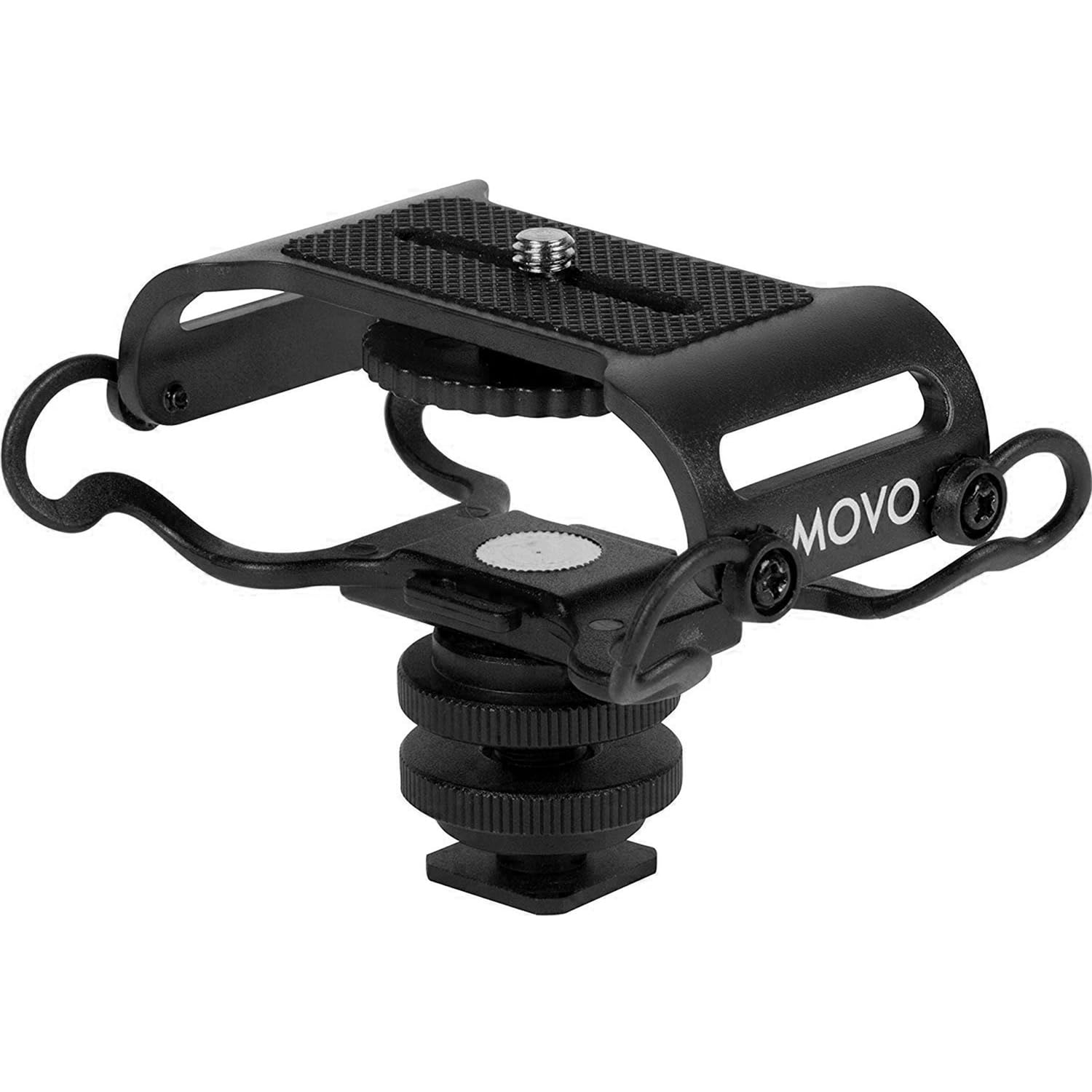
Portable recorders have a mounting problem: they are wider and heavier than a shotgun mic, and their controls sit exactly where a cradle wants to grip. The Movo SMM5-B solves it with a low-profile ABS cradle that attaches by hot shoe or 1/4-inch thread, so a Zoom H1n or Tascam DR-40x can sit on a camera or tripod without a separate cage.

We liked how little it adds. At 1.95 ounces, it does not make a compact recorder top-heavy, and the suspension takes the edge off handling noise when you move the rig. With an H1n or H2n, the mount disappears into the setup. With a larger H6, it is closer to its comfort limit, and the recorder can feel floppy on a camera.

The low profile means it stays out of the way when you frame a shot. We used it on a tripod as often as on a camera; the 1/4-inch thread makes that switch easy.

Pros

  • Hot shoe and 1/4-inch mounting
  • Low-profile ABS body
  • Reduces handling noise
  • Weighs under 2 ounces

Cons

  • Hot-shoe fit varies by camera
Our verdict

A light, low-profile mount for Zoom and Tascam recorders, especially when you need to keep handling noise off a camera track.

Check Latest Price
6

Best for Rode Mics

Rode SM6 Shock Mount

90 /100
Lab Score Outstanding

Key details

Weight
1.5 lb
Mic Fit
Large Rode mics
Pop Filter
Built in
Vertical Control
Hinged
View on Amazon

The built-in pop filter is the reason to consider the SM6 over a plain spider mount. Rode builds the pop shield onto a telescopic arm with two axes of adjustment, so you can place it in front of a large-diaphragm mic without adding a separate clamp and gooseneck to the stand.

We liked the integrated approach. The mount holds a Rode body securely, the hinged vertical angle control makes it easy to tilt the mic, and the whole assembly feels like one piece rather than a collection of accessories. For a solo voice setup, that is less clutter around the mic and one less thing to adjust.

The SM6 is not a universal cradle. It is sized for large Rode models, and the integrated filter is best when the mic stays in one vocal position. We preferred it for a dedicated vocal setup rather than a desk where the mic moves constantly.

Pros

  • Built-in adjustable pop filter
  • Hinged vertical angle control
  • Solid for large Rode mics
  • Removable pop shield

Cons

  • Hinge can slip under a heavy mic
  • Pop filter arm limits placement
Our verdict

For a large Rode condenser, the SM6 combines suspension, angle control, and a pop filter in one solid piece.

Check Latest Price
7

Best for Dynamic Mics

Boseen Dynamic Mic Shock Mount

88 /100
Lab Score Excellent

Key details

Weight
4.97 oz
Mic Fit
28-32mm
Material
Metal
Thread Adapter
5/8 to 3/8 inch
View on Amazon

Most shock mounts are too wide for a handheld dynamic mic, which is why this narrow Boseen cradle earns a place. It is sized for 28mm to 32mm bodies, the range that covers a Samson Q2U, Shure SM58, ATR2100-USB, and Behringer XM8500, and it grips the body instead of letting it rattle around.

We liked the metal frame and the strong rubber bands. It turns a stage mic into a usable desk or boom-arm mic without the bulky spider look, and the angle knob lets you tilt the mic toward your mouth. The 5/8-to-3/8 adapter means it fits the common stand threads without a separate purchase.

The clamp is the part that needs care. We tightened it firmly and left it alone, which is the right approach for a mic that stays in one place. For a handheld you plug in and move around, a simple clip is still simpler.

Pros

  • Fits 28-32mm dynamic mics
  • Metal frame with strong bands
  • 5/8 to 3/8 adapter included
  • Angle locking knob

Cons

  • Wing nut can strip if overtightened
  • Clips can pop out under force
Our verdict

This is the mount we pick for a handheld dynamic mic, with a narrow cradle that actually grips Q2U and SM58 bodies.

Check Latest Price
8

AT2020 Condensers

Etour AT2020 Shock Mount

89 /100
Lab Score Excellent

Key details

Weight
3.53 oz
Mic Fit
AT2020 line
Included
Foam windscreen
Thread Sizes
3/8 and 5/8 inch
View on Amazon

A custom cradle is the whole point of the Etour mount. It is built for the AT2020 line, with a holder that seats the mic body without the universal-mount compromise, and it includes a foam windscreen that doubles as a basic pop filter.

We liked how firmly it holds an AT2020. The cradle locks the mic in place even when the stand is angled or the mic is upside down, and the foam windscreen softens plosives without a separate round filter in front of your face. The 3/8- and 5/8-inch threads cover the usual stands, and the adjustment knob lets you set the angle once.

This is a model-specific mount, not a universal one. The AT2020 line is the target, and the fit is snug in the way a custom cradle should be. The plastic and foam construction is lighter and less premium than the metal spiders here, but it does the job for a desktop AT2020 setup.

Pros

  • Custom fit for AT2020 line
  • Holds mic upside down without sliding
  • 3/8 and 5/8 threads
  • Foam windscreen included

Cons

  • Not compatible with AT2020USB-X
Our verdict

For a standard AT2020 or AT2035, this is a snug, stable cradle with a useful foam windscreen included.

Check Latest Price
9

AT2020USB-X Mics

Audio-Technica AT8455 Shock Mount

90 /100
Lab Score Outstanding

Key details

Front
Open
Weight
3.63 oz
Mic Fit
AT2020USB-X and XP
Thread Sizes
3/8-16 and 5/8-27
View on Amazon

The open front is the detail that makes the AT8455 worth its place. Audio-Technica leaves the front of the cradle open so you can reach the AT2020USB-X or XP controls and see the indicators without pulling the mic out of the mount.

We liked the metal build and the clean fit. The mount absorbs vibration from the stand, the 3/8-16 and 5/8-27 threads cover both common stand sizes, and at 103 grams it does not weigh down a boom arm. For a USB mic with a mute button or gain dial, that access is more useful than another band or a bigger frame.

The AT8455 is narrow by design. It is the least fussy option for the two mics it serves, and we kept it on the AT2020USB-X while leaving the universal mount for everything else.

Pros

  • Open front leaves controls accessible
  • Fits both AT2020USB-X and XP
  • 3/8-16 and 5/8-27 threads
  • Metal construction

Cons

  • Only fits those two Audio-Technica models
Our verdict

If you use an AT2020USB-X or XP, this is the cleanest fit: open front, metal build, and proper thread options.

Check Latest Price

How We Tested Microphone Shock Mounts

We started with the mounts that keep turning up in studio forums, retailer best-seller lists, and the kits sold alongside popular condenser and dynamic mics, then narrowed by three things: the range of mic bodies each one claims to grip, the thread sizes and adapters in the box, and price. That left 12 mounts, which we used for six months across a desk podcast setup on a boom arm, a camera rig for field recording, a handheld recorder on a boompole, and a small home studio where people walk around while they talk.

Vibration isolation got the most attention, because it's the whole point. I mounted each mic, hit record, then tapped the desk, dragged a chair across the floor, and stomped past the stand, listening back for thumps and rumble that reached the file. I noted whether a heavy mic held the angle I set or slowly drooped over an hour, how much elastic actually contacted the mic body, and whether I could reach the bands to re-tension or replace them once they stretched.

Fit and compatibility came next. I measured every mic in the house and checked where each cradle landed in that range, then tightened and loosened each mount by hand to see how much force it took and whether the adapters seated flush. Pop filters got a real look too: whether the filter sat between mouth and capsule without crowding it, and whether it swung out of the way when it wasn't wanted. Finally, I tracked build quality over the full six months — finish wear, bent hardware, elastic that lost its snap — and weighed what came in the box against what it cost.

How to Choose a Microphone Shock Mount

Start with the mic body, not the word universal

A shock mount only isolates a mic if the cradle grips the body without touching the stand. Universal mounts usually state a diameter range or a set of bottom adapters, and that range is the first thing we check. A large condenser with a tapered body, a USB mic with knobs on the front, or a handheld dynamic can all miss a cradle that looks universal. Measure the mic where the bands sit, then compare that number to the listed fit. The Boseen universal mount earns its place here because four bottom screws cover more large-condenser mounting points than a single-thread frame.

Match the thread or shoe to your rig

Most studio stands and boom arms in the U.S. use a 5/8-27 thread; many European stands use 3/8-16, and adapters bridge the two. Camera rigs use a cold shoe, a hot shoe, or a 1/4-inch screw. Count the adapters included, but also think about the path: an adapter adds a joint that can loosen. The Elgato mount has a native 5/8 thread plus 3/8 and 1/4 adapters, while the SmallRig and Movo mounts are built around camera shoes. Pick the mount that reaches your stand without a stack of converters.

Judge the suspension by its wear parts

Metal frames look reassuring, but the elastic bands are what isolate the mic. A four-point suspension spreads the load better than a single band, and spare bands are a practical bonus because elastic stretches and silicone can tear. We look for bands that seat in hooks or slots rather than rely on friction, and we avoid stretching them farther than needed to load the mic. The SmallRig includes four silicone bands; the Rode SM6 uses rubber bushings that need checking at the hinge. If the mic starts to sag or the bands feel slack, replace them before the next session.

Decide whether the angle joint can carry your mic

A shock mount has to hold the mic at the angle you set, not just isolate it. Heavy condensers put leverage on the joint, and a small knob can slip under that load. We tighten the angle lock before letting go, and we check whether the mount uses a toothed hinge, a friction knob, or a simple ball joint. If you move the mic often, a firmer joint matters more than a few ounces of weight. If the mic stays in one position, a lighter mount with a basic knob is easier to live with.

Treat pop filtering and control access as separate choices

A shock mount does not remove plosives, and a pop filter does not stop desk vibration. Some mounts include a filter or windscreen, which saves clutter; others leave the front open so you can reach a USB mic's mute button or gain dial. We decide which convenience matters for the setup. The Rode SM6 and Etour include filtering, while the Audio-Technica AT8455 keeps the controls exposed. If you already own a pop filter you like, do not pay for a second one; spend the difference on a better-fitting cradle.

Frequently Asked Questions

Final Verdict

For most large-diaphragm condenser owners, the Boseen Universal Shock Mount is the one we recommend first. Its four bottom screws, metal frame, and 3.3-pound limit give it the widest useful fit in this group, and it stays stable on a boom arm without costing as much as a brand-specific cradle. It is not the mount for a handheld dynamic or a USB mic with front controls.

Those buyers have better-matched options: the Elgato for Wave mics, the Auphonix for a standard Blue Yeti, the Boseen dynamic cradle for a Q2U or SM58, and the SmallRig or Movo for camera and recorder rigs. Start with the mic body you own, and the choice gets simple.