Best Flight Simulator Cockpits of 2026

The first thing that gives away a bad flight simulator cockpit isn't how it looks — it's what happens when you pull back hard and the whole frame leans with you. A stick that shifts half an inch under pressure turns a smooth approach into a wrestling match, and no amount of practice fixes it. A cockpit's only real job is to hold your stick, throttle, and pedals exactly where your hands and feet expect them, with zero give.

I've spent eight months with 10 rigs set up in my sim room, and the spread is wide. Assembly ranged from a 20-minute bolt-together to an evening with a torque wrench, and some frames shrugged off a hard pull while others creaked like a porch swing.

The detail I'd flag for anyone shopping: mounting plates matter more than the frame's silhouette. A thick plate with slotted holes will accept a dozen different controls over the years; a thin one with two fixed bolt patterns fights you every time. Here's what held up, from combat sims to general aviation to rigs that swap over to racing.

1

Best Overall

Next Level Racing Boeing Edition

87 /100
Lab Score Excellent

Key details

License
Official Boeing licensed
Item Weight
108.9 lb
Cockpit Type
Dedicated flight
Control Compatibility
Major-brand yokes, sticks, rudders, throttles
View on Amazon

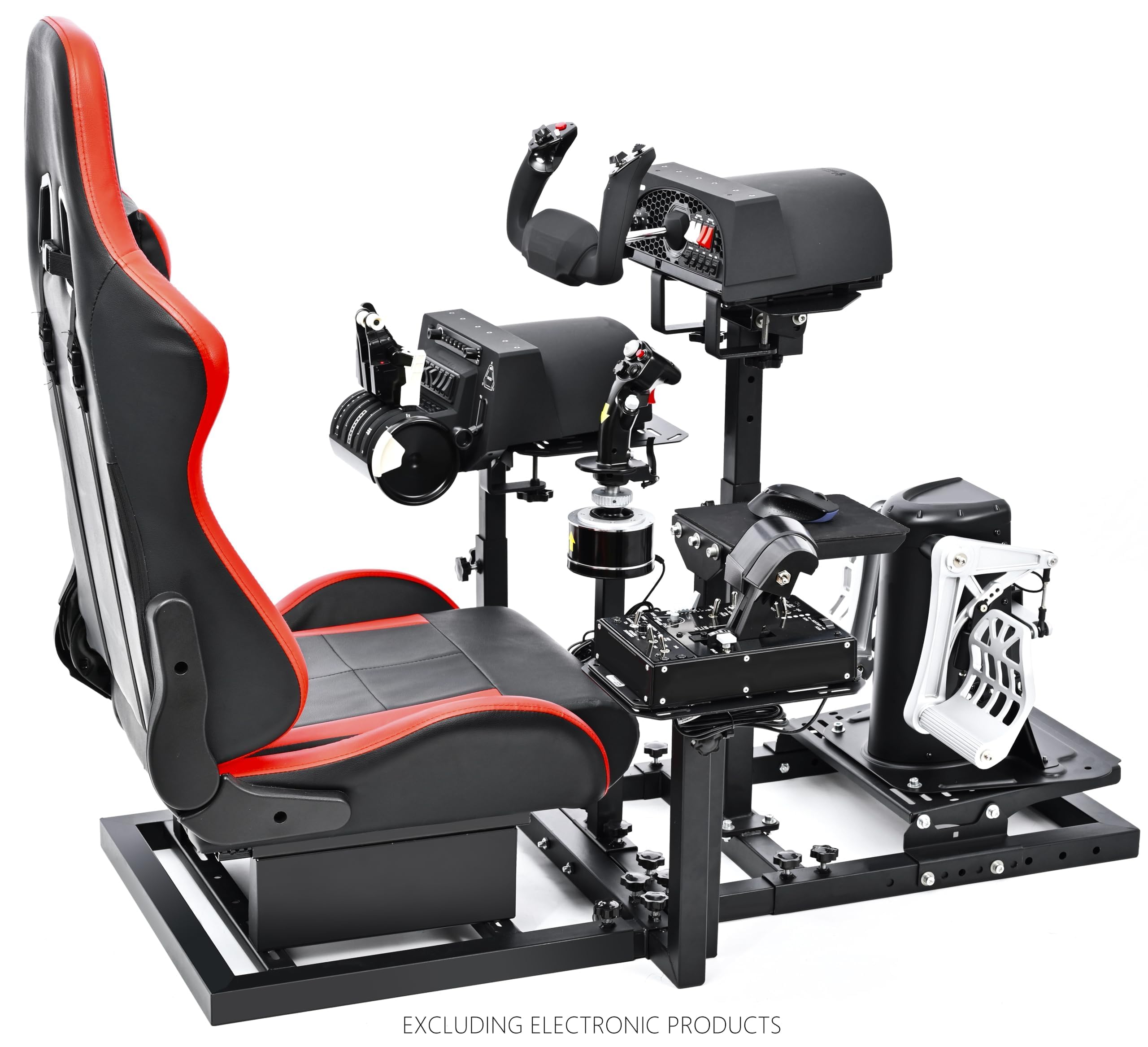
The Boeing Military Edition doesn't pretend to be anything but a cockpit: green canvas seat, military-green frame, and controls arranged around a seated pilot instead of bolted to a plate in front of a desk chair. The Boeing license is the fun part. The geometry is the useful part — a yoke, a throttle quadrant, and rudder pedals land where your hands and feet expect them, and the seating position puts you inside an aircraft rather than behind a wheel stand.

We think it's the best all-around choice here because it commits to flight and asks nothing of you in return for racing. Yokes, sticks, rudders, and throttles from all the major brands fit, and there's enough hardware in the box to mount a mixed setup without a run to the hardware store. The frame is heavy in the way that matters: our stick inputs didn't shiver the posts, and nothing crept across the floor. The build is a real project, though — clear instructions and included tools, but give it a few hours and clear the room first.

Getting in and out is the honest trade-off. There's no footwell beside the seat, so you step over the side of the frame, and in a tight room that gets old fast. Once you're in, the position is the reason to buy a dedicated cockpit: pedals ahead of your heels, throttle at hand height, and a seat that adjusts so a taller pilot isn't folded around the stick.

Pros

  • Dedicated flight layout with no racing compromise
  • Frame stays solid under heavy stick input
  • Mounting hardware covers all major control brands
  • Seat and controls adjust to fit different bodies

Cons

  • No footwell, so climbing in and out is awkward
  • Very heavy at 108.9 pounds
Our verdict

For a rig you sit inside rather than straddle, this is our pick: a dedicated flight cockpit with a rock-solid frame, wide mounting hardware, and adjustability that fits different bodies.

Check Latest Price
2

Best for Combat Sims

SimFab DCS Edition Cockpit

87 /100
Lab Score Excellent

Key details

Dimensions
60 x 40 x 41 inches
Item Weight
55 lb
Metal Warranty
Lifetime
Stick Compatibility
Thrustmaster, VirPil, VKB, WinWing
View on Amazon

Own a Warthog, a VirPil, or a VKB stick? This is the cockpit shaped around hardware like that. It has the stiffest chassis in this group and the most comfortable seat, and while it's expensive next to the stand picks, the money shows up where a combat simmer feels it: mount rigidity, a chair you can sit in for hours, and adjusters on the stick and throttle posts that hold where you set them.

The seat is the part we didn't expect to care about. It's a full-size foam chair with sliders and a recliner, and the foam insert lifts out so a center-mounted stick can sit between your knees — the detail that turns a racing seat into a combat cockpit. Height and width adjust at the mounts, and the frame is modular, so it can be upgraded toward general aviation, space, or racing rather than replaced. Metal parts carry a lifetime warranty; the upholstered parts get two years.

Assembly is documented better than most, with parts in labeled bags and a manual for each module, which helps because the chassis breaks down into four sub-assemblies that can be moved separately. Check the compatibility list before you order. Thrustmaster, VirPil, VKB, and WinWing gear is covered, but some controls need optional brackets, so confirm what ships with your configuration.

Pros

  • Rigid chassis that shrugs off heavy stick loads
  • Full-size reclining seat with removable center-stick insert
  • Mounts adjust in both height and width
  • Lifetime warranty on metal parts

Cons

  • Some controls need optional mounting brackets
  • Premium price next to the other picks
Our verdict

If your stick is a Warthog, VirPil, VKB, or WinWing, this is the cockpit built around it — the stiffest frame here, the most comfortable seat, and room to grow.

Check Latest Price
3

Best Flight and Racing Rig

Marada 2-in-1 Flight Cockpit

86 /100
Lab Score Excellent

Key details

Item Weight
96.5 lb
Frame Tubing
40mm square steel
Mounting Panels
5 interchangeable
Brand Compatibility
Logitech, Thrustmaster, Honeycomb, Turtle Beach
View on Amazon

Five swappable panels are the reason to look at this rig. Bolt in one set and the frame carries a yoke and a throttle quadrant; change panels and the same seat becomes a racing cockpit with a wheel and pedals. If you fly and drive and can't give up the floor for two rigs, that flexibility is worth more than any single line on the spec sheet.

The frame is 40mm square steel tube, welded at right angles, with dual hand bolts at every adjustment point and anti-slip pads under the seat. Our mounts stayed put through a session of hard stick work. The side joystick panels move six ways, so a side-stick layout and a center-stick layout are both reachable, pedal position and angle tune independently, the seat and backrest adjust, and a flat board at the side takes a mouse and keyboard.

Against the dedicated cockpits, this is the value play: the same solid feel under your hands for less money, plus a racing mode they don't have. What it doesn't do is put you in a jet posture. The seat sits low relative to where a flight stick wants to be, so raise the middle plate, set the panel height against your own reach, and tighten everything before you trust it with a long sortie.

Pros

  • One frame for flight and racing
  • 40mm welded steel tube with dual hand bolts
  • Wide brand compatibility, hardware included
  • Six-way adjustable stick panels and tunable pedals

Cons

  • Seat sits low for a flight-style posture
  • Heavy at 96.5 pounds once built
Our verdict

Our pick if you fly and race: five swappable panels let one sturdy frame hold a yoke or a wheel, and it costs noticeably less than the dedicated cockpits.

Check Latest Price
4

Best Cockpit Chair

Marada Flight Sim Chair

80 /100
Lab Score Excellent

Key details

Casters
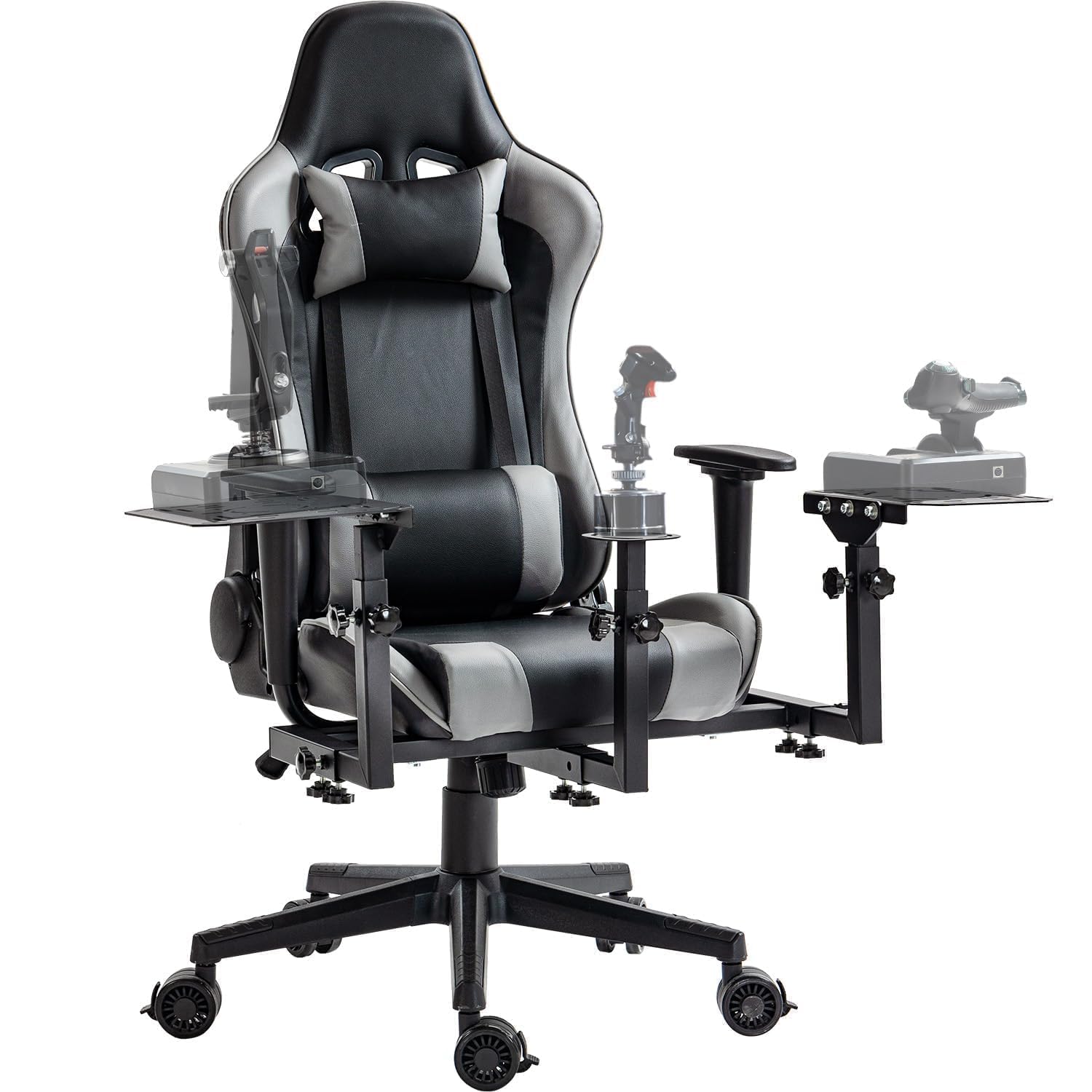
5 locking
Backrest
90-180°
Item Weight
57 lb
Load Rating
300 lb
View on Amazon

Roll it to the desk, lock the five casters, and it's an office chair; roll it back and the stick and throttle are still exactly where you left them. For anyone whose sim gear lives in the same room as everything else, that's a compelling trick.

We think it's the right compromise for a small room. The seat is a reclining gaming chair on a laser-welded steel frame rated to 300 pounds, and the backrest runs from upright to nearly flat for long sessions. The stick and throttle bracket rises with the seat, so raising the chair doesn't bury your knees in the mount, and the casters lock firmly enough that the chair stays put under pedal work — more than you can say for a wheeled office chair on a bare floor.

What you give up is comfort at the edges. The padding is firm, so after a few hours you'll want a cushion or a break. The frame itself doesn't flex and the build is simple enough to do alone. It's also not a cockpit in the full sense — there's no surround, just a chair with a mount frame in front of it — but that's the trade for something you can also work at.

Pros

  • Chair and control mounts in one unit
  • 300-pound rating on a laser-welded steel frame
  • Locking casters hold position under pedal input
  • Backrest reclines from upright to nearly flat

Cons

  • Firm padding for long sessions
Our verdict

A real chair with a steel stick-and-throttle frame bolted to the front — the sensible middle path when the rig has to share a room with your desk.

Check Latest Price
5

Best Budget Folding Stand

GTPLAYER Flight & Racing Stand

90 /100
Lab Score Outstanding

Key details

Frame
High-strength carbon steel
Storage
Folds flat
Wheel Plate Tilt
20 degrees
Height Adjustment
20 cm range
View on Amazon

The least expensive stand in this group, and the one that folds flat enough to slide under a couch or stand in a closet corner. If your sim gear has to disappear between sessions, that matters more than any other line on the box.

The frame is high-strength carbon steel with a height range of about 20 centimeters and a wheel plate that tilts through 20 degrees. It ships with five fixed wheels for a chair plus two sliding ones, so you can park a rolling office chair in front of it without chasing it across the room. The slotted plates are pre-drilled for most mainstream wheel, pedal, and stick bases.

We rate it as the budget entry and not much beyond that. On a hard floor it slides when you press hard into the pedals, and a rubber mat under the frame fixes most of that. Mounting is the other catch: the slots take most mainstream bases, but the holes don't always line up cleanly, and bent legs or damaged threads are the risk at this price — inspect the frame before you build.

Pros

  • Folds flat for closets and corners
  • Height and wheel-plate tilt adjust
  • Steel frame with slotted, pre-drilled plates
  • Includes chair wheels to keep a rolling seat put

Cons

  • Slides on hard floors under hard pedal input
  • Some mounting holes don't line up
Our verdict

The least expensive way into a steel flight stand here, and the one to buy if the rig has to fold away into a closet between sessions.

Check Latest Price
6

Tight Spaces

Anman Foldable Flight Stand

77 /100
Lab Score Very Good

Key details

Storage
Folding pedal deck
Assembly
80% pre-installed
Dimensions
37.5 x 38.4 x 28.3 inches
Shift Panels
3
View on Amazon

Anman's stand sits in the same budget bracket as the GTPLAYER and makes a different bet: three shift panels and a folding pedal deck rather than one large folding frame. We think it's the better buy if you already have a wheeled chair you like, since the front cradle locks those wheels and saves you paying for a seat you don't need.

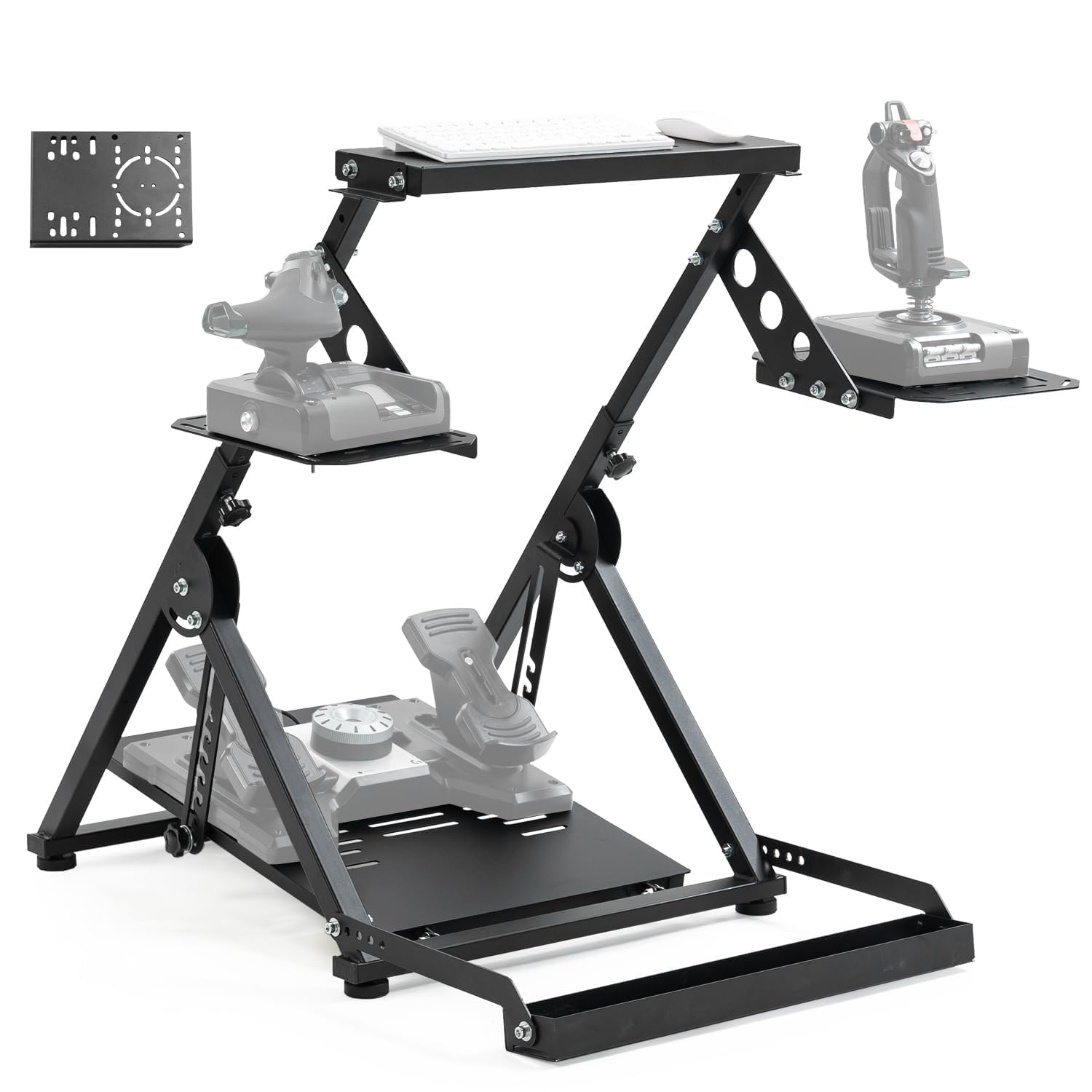
Eighty percent of it arrives pre-assembled, so setup is short, and the X-shaped double-triangle brace keeps the column steady in ordinary use. The three side plates let you run a yoke and quadrant one weekend and a wheel the next, and the pedal section folds down so the whole thing stores narrow. It's heavy for something sold as foldable, which is what steel this thick costs you.

The pedal bay is the part to measure before ordering. The support arms sit close to the tray, and wide rudder pedals can foul them before they're fully seated, so check your pedal spread against the tray width. The panels themselves are wide and pre-drilled, and there's enough hardware in the box to mount a mixed flight setup without a second order.

Pros

  • Mostly pre-assembled, so setup is quick
  • Three shift panels for flight or racing
  • Folding pedal section stores narrow
  • Wide, pre-drilled control panels

Cons

  • Support arms crowd wide rudder pedals
Our verdict

Buy it if you want a stand that folds, you already like your wheeled chair, and you don't need the frame to become a full cockpit.

Check Latest Price

How We Built, Flew, and Judged 10 Flight Sim Cockpits

We started by rounding up every cockpit, stand, and chair-mounted rig we could find that advertised real control mounts rather than a single wheel deck, then filtered on three things: whether the bolt patterns matched the stick and throttle bases people actually own, whether the frame was steel or aluminum instead of tube with plastic clamps, and whether it fit in a normal room. That left 10 units, which we built and flew for eight months.

Assembly came first. I built each one solo using only the tools in the box, timing the build and noting where the instructions skipped a step or a hole needed persuasion. Then I mounted a stick, throttle, and pedals and checked the things that decide whether a rig works: whether the holes lined up without drilling, whether the plates had slots to move a control closer or higher, and whether the frame sat flat on carpet.

Then we flew. Every rig got the same routine — combat sorties with hard pulls and fast throttle work, general aviation patterns that need small corrections, and for the convertible ones an afternoon switched over to a wheel. I watched for movement: a stick plate that flexed under a firm pull, pedals that crept across the floor, a seat that rocked on its frame, bolts that needed retightening after a few weeks.

The last stretch was about living with them — sliding a seat in for shorter legs, raising a mount for a longer reach, adding a second control the way you would after an upgrade, and taking stock of what came in the box, since several of these arrive as frame only with no seat and no electronics.

How to Choose a Flight Simulator Cockpit

Start With Your Controls, Not the Frame

The rig has to accept what you already own. A brand list in the specs is reassuring, but the panel is what matters: slotted plates and multiple bolt patterns forgive a base that doesn't match the drawing, and a single fixed hole pattern does not. The Marada rigs lean on five panels and a bag of hardware; the SimFab is drilled for specific high-end sticks and needs optional brackets for others. Measure your yoke, throttle, and pedal bases before you fall for a frame.

Rigidity Lives at the Joints

A welded steel frame is only as steady as the points where the mounts clamp on. Dual hand bolts that pinch a panel against square tube, the way the Marada cockpit does, hold better than a single thumbscrew, and a stick post that flexes a couple of degrees shows up in every landing. Look at how the stick, throttle, and pedal plates lock before anything else: friction clamps can be retightened, welded tabs cannot. If a rig has one soft spot, it's the post you push hardest.

Set the Seat for Flight, Not Driving

Flight sims want a different posture than racing: hips lower, legs longer, stick falling between the knees rather than sitting at chest height. That's why a rig built around a car seat can leave the stick too high, and why a dedicated cockpit like the Boeing edition places the controls where an aircraft does. Set pedal distance first, then seat height, then the stick and throttle. If two people share the rig, mark your settings — every adjuster you own will get moved.

Space, Weight, and What Folding Really Means

Folding saves floor space, not effort. A folding stand is still steel, and the full cockpits here run from 55 to nearly 109 pounds and don't move once built. Measure the footprint you can leave set up, add the room the pedals need in front of it, and decide whether the rig lives in place or goes into a closet. A chair-style rig such as the Marada is the middle case: it rolls, but it still needs a clear patch of floor while it's working.

Budget for the Build

Every rig here arrives in pieces. Assembly ranges from a short session, like the Anman stand that comes mostly pre-assembled, to a multi-hour project with labeled bags and a manual per module, like the SimFab. Included tools are common but not universal, and a second pair of hands helps on anything over 90 pounds. Warranties run from three months on the Marada frames to a lifetime on SimFab's metal parts, so read that line before you give up a weekend to it.

Frequently Asked Questions

Final Verdict

The Next Level Racing Boeing Military Edition is the cockpit we recommend to most people. It's built for flight only, its mounts take the major brands' yokes, sticks, and pedals, and the frame stays still when you lean into it — the closest thing here to sitting in an aircraft rather than in front of one. The tight footwell is the price of that posture.

If your hardware is a Warthog, VirPil, or VKB setup, the SimFab DCS Edition is the better buy: stiffer still, more comfortable for long sessions, and shaped around those mounts. And if you race as often as you fly, the Marada 2-in-1 saves you a second rig.